Monday, 30 July 2012

Olympics Opening Ceremony


What an amazing piece of theatre design went into the opening ceremony of the Olympics See how some of it was done at:


There are interviews with the Olympic Cauldron Designer, Thomas Heatherwick at:


and at: <!-- Start of guardian embedded video -->

                    <!-- To prevent the video from auto playing set 'a=true' in the following line of code-->

                    <iframe src="http://gu-embedded-video.appspot.com/?a=false&i=brightcove/poster/2012/5/29/120530ThomasHeatherwick_6239078.jpg&f=brightcove/2012/5/29/120530ThomasHeatherwick-16x9.mp4&u=/artanddesign/video/2012/may/30/thomas-heatherwick-vanda-show-video&tn=Thomas Heatherwick takes a tour through his London V&A show - video:Video:1752630" style="border:0; overflow:hidden;" scrolling="no" width="460px" height="397px"></iframe>
                    <!-- End of guardian embedded video -->

Friday, 13 July 2012

Paul Simon in Concert at the 02, Dublin

Last night (Thursday 12th July) I had the good fortune of being treated to see and hear Paul Simon in Concert at the 02. The concert featured the Graceland suite including the Ladysmith Black Mambazo, whose vocals, with their distinctive rhythm and cadence are only astonishing. The main feature was of course Paul Simon himself, who performed to the delight of his audience with great panache, energy and completeness. A live performance by an artist of the calibre of Paul Simon and his team could only be mesmerizing as this concert was and his performance was further enhanced by emotionally charged moments that bonded audience and performers in momentary unified entity.

From a Scenographer’s (Set Designer) the stage presentation was visually and logistically well thought out. Bearing in mind that this is a touring show, it was a visually appealing apparently simple and smart presentation. The stage surface had a light tonal finish which worked well with the coloured lighting and projected imagery.


Hanging over the back of the stage was a composition of three large panels onto which images appeared to be projected. They could have been large Plasma or LED screens with a queued programme of images fed to them interspersed with a feed from the onstage cameras. In all the presentation (despite some very jerky and abrupt lighting changes) worked well and supported the atmosphere and ambiance of the concert more than it hindered it.

Patrick Molloy for www.stagebrace.com

Tuesday, 10 July 2012

Tom Murphy’s “The House” at the Abbey Theatre

Tom Murphy’s “The House” at the Abbey Theatre, Designed by Paul O’ Mahony a graduate of IADT P.Des and Motley Theatre Design School, London. http://paulomahonysetdesign.blogspot.ie/


Costumes by Niamh Lunny a graduate  of Limerick College of Art & Design
http://www.linkedin.com/pub/niamh-lunny/35/166/746
This is a must see for students and professional practitioners alike of Scenography, Design for Stage & Screen and Theatre/Stage Craft.

I think this is the last week of its run at the Abbey, check it out at:

Paul’s set design is a very clever, well thought through solution that is visually very satisfying and works extremely well in all aspects expected of a stage set. The sets lend an appropriate level of ambience to each scene, assigning a restrained supportive sense of place and period style to each act. The transitions from scene to scene are magical in themselves and speak volumes for the professionalism, technical wizardry and stag craft competence of the Designer, the Abbey team and the construction team.

Niamh Lunny’s Costume Designs lend credibility to the characters and supported the performances of the cast in doing so. Her costumes, supported by make-up and hair designers; Val Sherlock and Lorraine Brennan established the social standing and occupation of the characters and set them in a time and place.
Lighting Designer Chahine Yavroyan’s collaborative contribution, enhanced the ambience and atmosphere of the presentation and augmented the dramatic moments with her deft lighting

Patrick Molloy for www.stagebrace.com

Thursday, 28 June 2012

Study Centre for Scenic Arts


Have a look at this, regards Patrick at stagebrace.com

Maria Harman [mharman@thescenographer.com]
Actions
To:
M
info@scenic-fest.com
22 June 2012 19:03
Dear Friends and Colleagues,
This is to let you know that the Study Centre for Scenic Arts (SCSA) has posted a cluster of filmed interviews with prominent names in contemporary scenography. Please take a moment to peruse our Stagecraft and Lectures pages at: www.scenic-fest.com where you will find exclusive interviews shot during the events we organised in Europe from 2008 to 2011. New videos will be posted every month while we generate an archive accessible to all.
The Study Centre is committed to generating a database of AV documentation and other material on contemporary scenography and related subjects, to be made available to academics, teaching staff, students and postgraduates, industry professionals, creative and technical minds alike.
I'd like to remind you that the Study Centre has opened the registration for membership. We already count almost 200 SCSA members and we hope that you, too will consider membership if you have not already signed up. Benefits include free entry to events and discounts on selected items. Check the Members' Space on our web site for details.
If you would like to be involved in our activities or collaborate with the Centre, as a signed-up SCSA member, we invite you to put your name forward to join our Scientific Committee. Details can be found on our web site.
Don't forget - our upcoming conference on contemporary scenography and scenic architecture takes place in Bologna from 17 to 21 October. You'll find event details, programme, updates and registration forms at: http://www.wix.com/i24423/scenic-fest#!training
Thank you for your time and we hope to see you in Bologna later this year.
Maria Harman
IFSArts /SCSA co-director
Tel. +39.(0)763.341667
Italy cell. +39.347.4390813

Monday, 18 June 2012

Rough Magic’s “Travesties”

Rough Magic’s “Travesties” at the Pavilion Theatre, Dún Laoghaire

Last night (Saturday 16th June) I saw Rough Magic’s http://www.roughmagic.ie/  production of Tom Stoppard’s “Travesties” at the Pavilion Theatre, Dún Laoghaire http://www.paviliontheatre.ie/


Costume Design by Bláithín Sheeran

Lighting Design by Sinéad McKenna. http://www.sineadmckenna.com/


The realisation of Lynne Parker’s concept for the set is a multifaceted well thought out piece of scenography and examples the potential of possibility that can manifest from the close collaborative engagement between Director and Designer(s); in this case Director and Set Designer being one and the same person.  

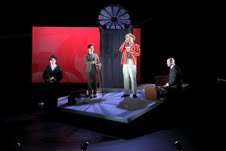
While the whole performance space is ensconced in a dressed black limbo, it is subdivided into a number of smaller dressed and lit acting spaces by a large island set piece consisting of a large diagonally positioned rectangular, raked rostrum rising from +500mm on the downstage/onstage edge to +1000mm on the upstage/stage left edge. The rostrum accommodates a vertical double door entrance/exit positioned on a smaller, level rostrum inset upstage on the raked rostrum. The frame of the double doors is surmounted by a large circular rose pattern fanlight, which apart from its symbolism, when it is lit from above it acts as a gobo casting a central hub and spoked pattern onto the rostrum top and stage floor. The upstage +1000mm edge of the rostrum acts as a writing/counter top, the onstage edge as a sideboard and the downstage edge as a step/seat. It affords interesting patterns of movement and positioning for the performers.


The downstage left corner is symbolically dressed with some large scientific instruments (and a baseball bat) appropriate to the period. Whereas the down stage right side, while also symbolically dressed, also has an (narrators) armchair, side table (draped with a Union Jack) reading lights and a rocking (Hobby) horse. Up stage right accommodates layers of written words on transparent plastic curtains which form a chicane or maze of words through which characters can hide from each other, miss each other and/or enter/exit upstage right through a backlit door. Up stage, centre back is a high chrominance back lit projection screen which, on occasion has shadows of down stage items projected onto it.

The real magic of the set is the double doors through which characters appear and disappear in the “Harry Potter” mode of travel. It forms a portal, a magic wardrobe portal to and from another place, not only for the appearance/disappearance of the characters but also for the physic of the audience to follow and join the characters in different places.  The illusion is well supported by a nifty piece of theatrical stage craft.

Lighting Designer Sinéad McKenna, as can be expected, enhanced the ambience and atmosphere of the presentation and augmented the dramatic moments with her deft lighting. To me, the low angled up light effect of the “Foot Lights” on the floor at the apron edge added to the period and theatrical presentation of the work.

Bláithín Sheeran’s Costume Designs lend credibility to the characters portrayed and enhances their assessment of self, their social standing, occupation and sets them in a time and place. The collaboration between Bláithín Sheeran, Costume Designer and Hair and Make-Up Designers Catherine Argue and Val Sherlock gave good supportive visual impact and expression to the characters.

A lot for students of Design for Stage, Screen and Performance to see and ponder in this production
Showing from: June 7th to 23rd at 8pm.
Follow us on facebook: 
Patrick Molloy for http://www.stagebrace.com

Friday, 15 June 2012

“Travesties” at the Pavilion Theatre


Tomorrow evening (Saturday 16th June) am looking forward to seeing Rough Magic's http://www.roughmagic.ie/  production of Tom Stoppard’s “Travesties” at the Pavilion Theatre, Dún Laoghaire http://www.paviliontheatre.ie/ Directed by Lynn Parker, Costume Design by Scenographer Bláithín Sheeran http://www.irishplayography.com/person.aspx?personid=528  and Lighting Design is by Sinéad McKenna.


Showing from: June 7th to 23rd at 8pm.

I will post comments/impressions on Set, Costume & Lighting Design over the weekend.

Patrick Molloy for http://www.stagebrace.com

Monday, 4 June 2012

The Country Girls


The Country Girls


Last Thursday night (Thursday 31st May) I saw Edna O' Brien's stage play "The Country Girls" at the Gaiety Theatre Dublin. The Country Girls (set in the 1950s) was first published in 1960 as a book and premiered as a stage play at Garter Lane Theatre, Waterford, in October 2011, produced by Red Kettle Theatre Company in association with Garter Lane Arts Centre, Waterford, Ireland 

The Set was designed by Ben Hennessy. Ben is a Founder Member and Artistic Director of Red Kettle. He works as a director, designer, writer and painter and in this instance; he brings a painterly quality to his scenographic interpretation for this traveling set for The Country Girls. While the script’s author Ms. Edna O’Brien is quite prescriptive on how the stage is set and to an extent how it looks (a touch of Beckett), Ben Hennessy’s solution satisfies the needs of a traveling set for a travelling show on a restricted budget at the expense of a more enhancing solution.  


A painted curved backcloth, a painted floor cloth and four masking pieces of hanging gauze masking the wings, define the performance space and are the constant environment in which the play unfolds.  

The painted curved backcloth and the painted floor cloth are both painted in broad strokes in tones of white to dark grey (a la Sean Scully-esque). A useful technique whereby the lighter paint tones pick up and reflect any coloured light used by the Lighting Designer (Conleth White) to accentuate a dramatic moment, an atmosphere, an emotional moment or place, etc. 

The hanging legs of Gauze/Muslin masking the wings also pick up the ambient light and one is used in the traditional way to hide & reveal a statue.

Up stage left and right are what appear to be two steel tube scaffold platforms with steps. These constructions also remain on stage throughout the two Acts of the play. They work at indicating an upstairs first floor in Kate’s home and as Pulpit in the Convent, and Gang Planks in the closing scene,

The only visual contribution to establishing the period in which the story is set comes from the Costume Designer Léonore McDonagh. Through her Costume Designs, Léonore McDonagh establishes the characters, their age, their gender, their socio-economic standing, occupation and their demographic and contributes hugely to establishing the where and when of the play.

Foot notes:

The action piece of hanging of clothes on a manually held cloths line was an effective and visually appealing solution to a piece of action. 

The small down stage left, boxed in flowerbed while giving a sense of exterior, becomes utilitarian when Sister Mary buries Kate’s copy of Joyce’s Dubliners.   

The script mentions a “feather Christmas tree” action prop for the Christmas holidays scene which I must have missed because the scene could have done with it. While the snow effect lighting supported the seasonal ambience a small Christmas tree would have clinched it. 

It is a useful set, if on the drab side of the solution. See the play and see what you think of the Set, the Lighting and the Costumes and how they all work to support the script.   

Tour of Ireland 2012:
Dean Crowe Theatre, Athlone
Monday 4th June –Tuesday 5th June

Glór, Ennis
Wednesday 6th June – Thursday 7th June

Hawk’s Well Theatre, Sligo
Friday 8th June – Saturday 9th June

Cork Opera House
Monday 11th June – Saturday 16th June

Town Hall Theatre, Galway
Monday 18th June – Saturday 23rd June